
How to Test a Tractor Battery With a Multimeter — 12V Guide
We have all been there — head in hands, obligatory cursing, realising the tractor battery is flat exactly when you need the tractor most. Five minutes with a multimeter tells you whether you need a new battery, a new alternator, or just a change of habit.
Quick answer
Set a multimeter to 20V DC. Connect red to positive, black to negative — directly on the battery terminals, not the quick-access ports. A healthy charged battery reads 12.6–12.8V with the engine off. With the engine running, the alternator should push the reading to 13.8–14.4V. Below those numbers tells you where the problem lies.
12V battery voltage reference table
Resting voltage — engine off, no load
| Voltage | State | Action |
|---|---|---|
| 12.7V – 12.8V | Fully charged | Battery is in good condition |
| 12.4V – 12.6V | Good charge | Battery is healthy — check alternator if not starting |
| 12.2V – 12.4V | Half charged | Recharge and retest — investigate cause |
| 12.0V – 12.2V | Low | Recharge — battery may be failing |
| Below 12.0V | Flat / discharged | Recharge fully and retest — likely needs replacement |
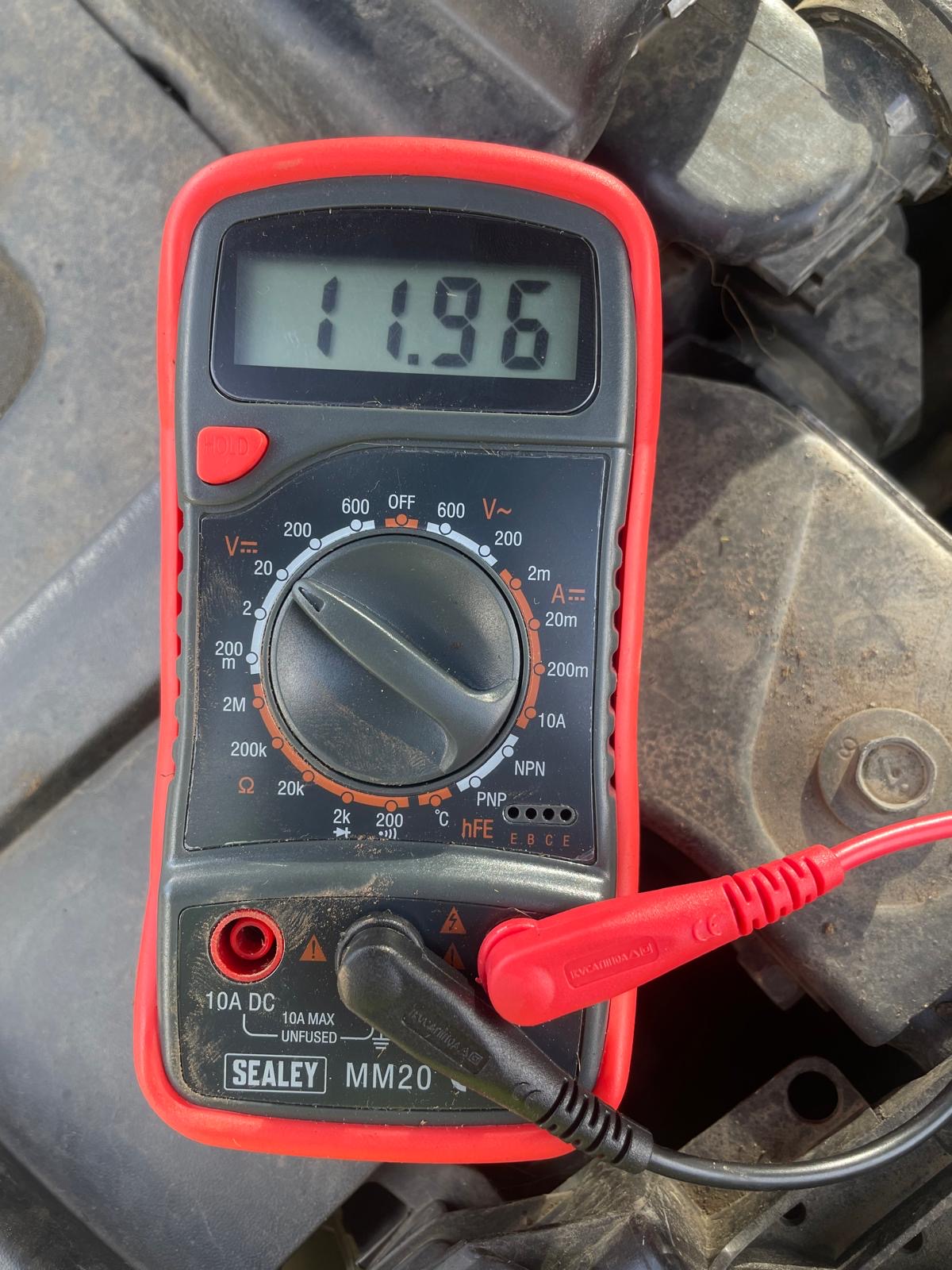
11.96V — a flat tractor battery. Anything below 12.0V means the battery is fully discharged and may need replacing
Why bother testing — just jump start it and go?
Most people get the jump leads or the battery booster out, get the tractor going and crack on. That works today — but it doesn't tell you why it went flat, which means it will happen again.
Testing the battery before and after a charge tells you whether the battery itself is the problem or whether something else is draining it. A low voltage reading before charging and a reading that doesn't recover after charging points to a battery that needs replacing. A battery that charges up fine but drains quickly points to a parasitic draw or a faulty alternator.
Spending five minutes with a multimeter now can save you the cost of an unnecessary battery replacement — or avoid the bigger problem of finding out your alternator is failing at the worst possible moment.
What causes a tractor battery to go flat?
What you need
How to test a tractor battery — step by step
Safety first
It might seem over the top putting on gloves and safety glasses just to test a battery, but batteries can generate electrical sparks and, in worst cases, release acid — particularly on older batteries in rough condition.
Make sure the tractor is parked safely following safe stop procedure — all operational levers in neutral, PTO disengaged, handbrake on. If you are working around other vehicles or livestock, make sure the working area is clear before you start.
Prepare the battery terminals
Modern tractors often have their batteries tucked behind guards or under the cab, but the farming environment ensures that dust, dirt, slurry and debris finds its way in everywhere.
Before connecting the multimeter, clean the battery terminals with a wire brush or sandpaper to remove any corrosion, dirt or debris. Corroded terminals create resistance and will give you a false low reading. A spray of battery terminal cleaner can help if the corrosion is heavy.
Set the multimeter
Set the multimeter to the DC voltage setting — usually marked with a V and a dotted line above a solid line. Select the 20V range, which covers the 12V battery range comfortably.
If your multimeter auto-ranges, just select DC voltage and it will set the range automatically.
Connect the multimeter — engine off
Connect the red lead to the positive battery terminal (marked + or red) and the black lead to the negative terminal (marked − or black).
Important: always connect directly to the battery terminal posts — not to the quick-access test ports found on some modern tractors. Other electrical components drawing power through those ports will give you a false reading.
Read the resting voltage
With the engine off and no load running, read the voltage on the multimeter display. Use the table below to interpret the result.
A fully charged, healthy 12V battery should read between 12.6V and 12.8V. If the reading is above 12.6V and the tractor still won't start, the battery itself is unlikely to be the cause — look at the starter motor, earth connections, or other electrical issues.
Load test — engine off, lights on
To test the battery under load, turn on the tractor's headlights or another high-draw electrical component while the engine is still off. Watch the voltage reading on the multimeter.
A healthy battery will hold close to its resting voltage. If the voltage drops sharply to below 11.5V with just the headlights on, the battery is struggling to deliver current and is likely failing even if the resting voltage seemed acceptable.
Test the alternator — engine running
Start the tractor (or have someone start it for you) and read the voltage again with the multimeter still connected to the battery terminals. Make sure all levers are in neutral and nobody is in the cab before cranking.
With the engine running, a healthy charging system should read 13.8V to 14.4V — this is the alternator charging the battery. If the reading stays below 13.5V with the engine running, the alternator is not producing enough charge and the battery will slowly drain with every use regardless of how good the battery itself is.
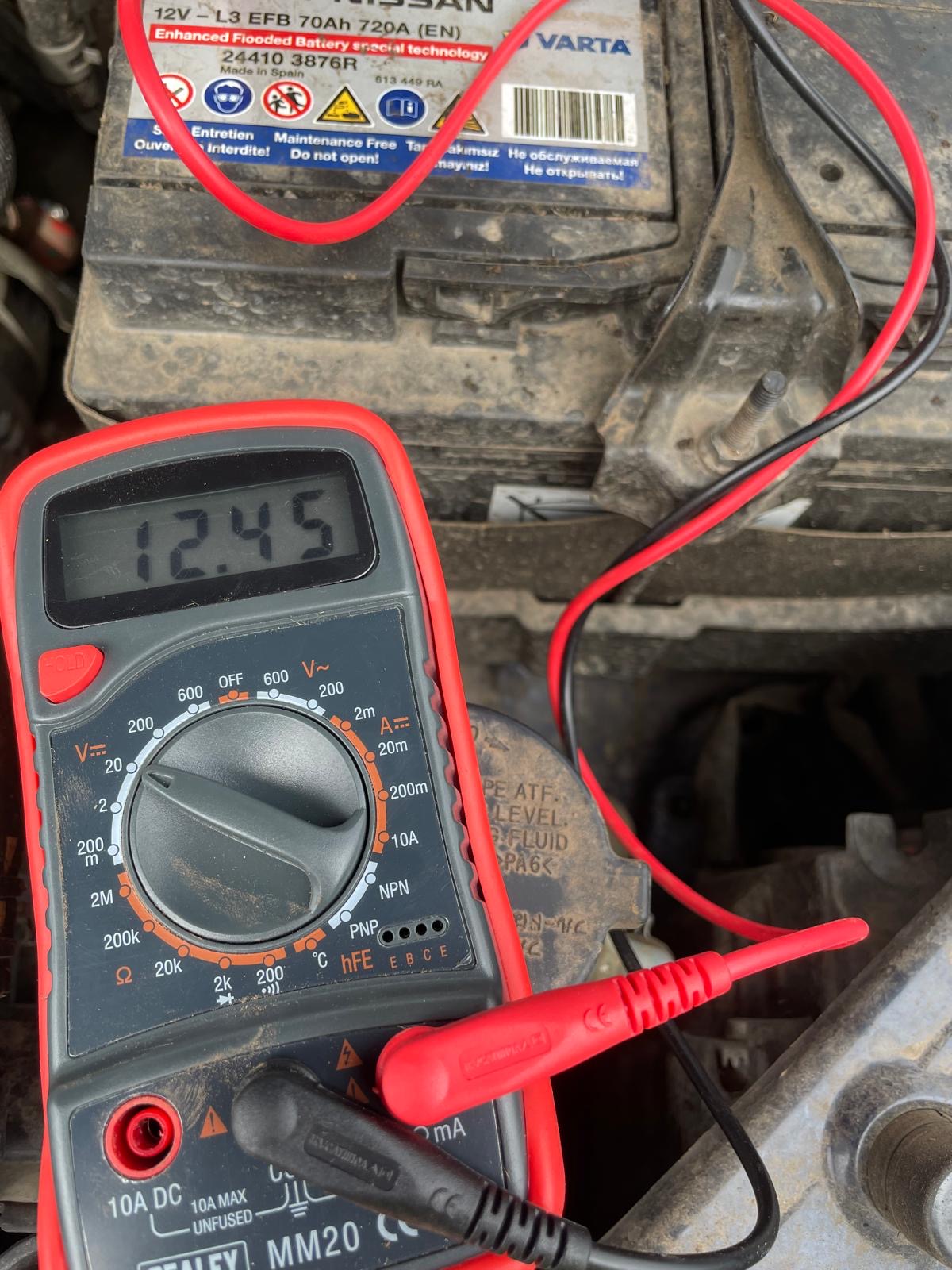
12.45V — a healthy tractor battery resting voltage. Between 12.4V and 12.8V means the battery is in good condition
Don't overlook the alternator
A battery that keeps going flat despite being in good condition almost always points to an alternator not producing enough charge. With the engine running at normal idle, connect your multimeter to the battery terminals — a healthy charging system reads 13.8V to 14.4V. Below 13.5V and the alternator is not keeping up. Above 14.5V and the voltage regulator may be overcharging and damaging the battery.
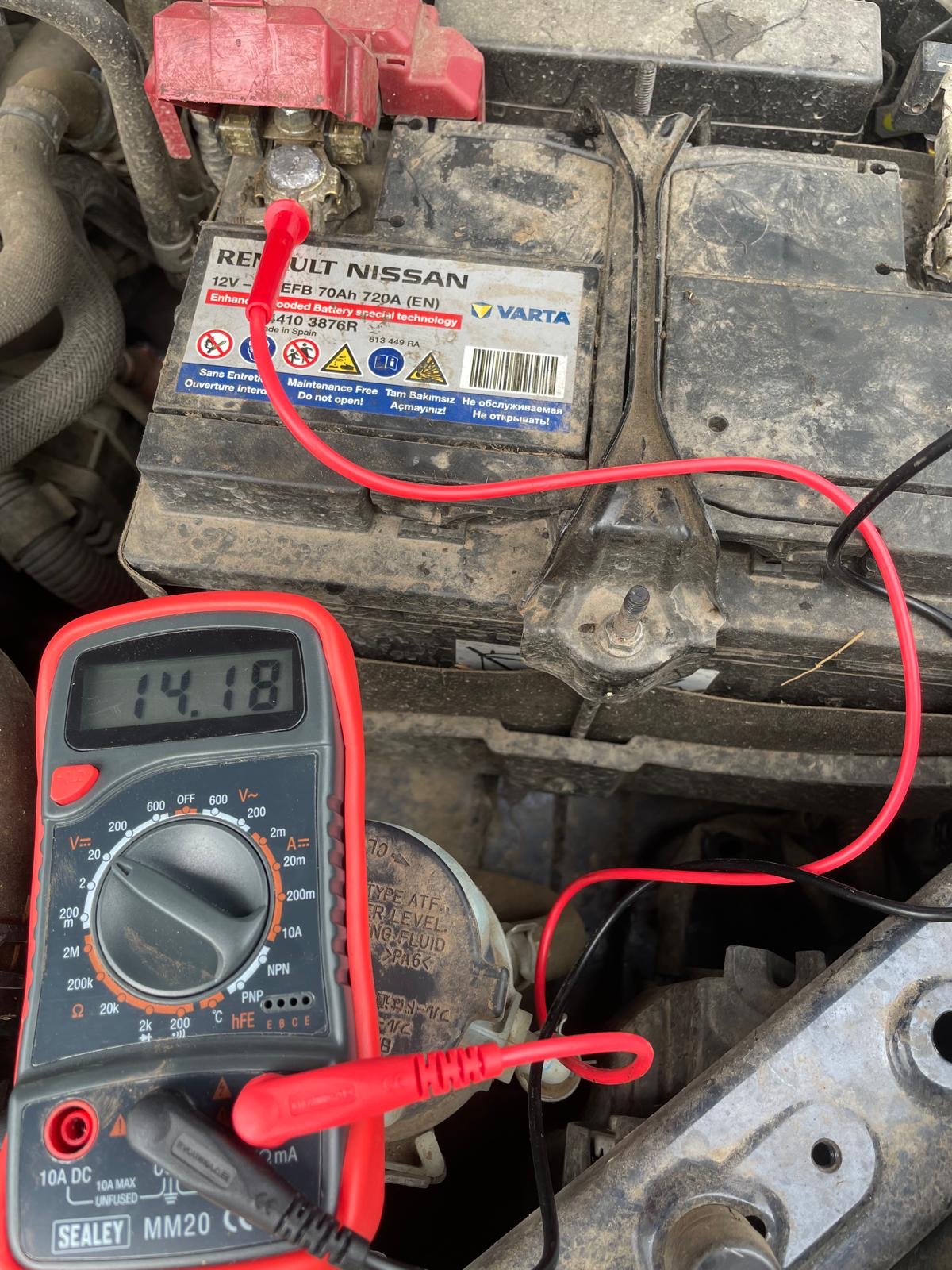
14.18V with the engine running — the alternator is charging the battery correctly. Healthy range is 13.8V to 14.4V
Interpreting the results
Battery reads 12.6V+ before charging, tractor still won't start
Battery is not the issue — check starter motor, earth connections and main fuse
Battery reads below 12.0V, recovers to 12.6V+ after a full charge
Battery is functional — investigate why it discharged. Check for parasitic draw or alternator output
Battery reads below 12.0V and won't recover above 12.4V after a full charge
Battery is failing and needs replacing
Battery charges fine but keeps going flat within days
Parasitic draw or faulty alternator — test alternator output with engine running
Engine running but multimeter shows below 13.5V at battery terminals
Alternator is not charging the battery sufficiently — have the alternator tested
Tools and parts mentioned in this guide
Affiliate links — we may earn a small commission at no extra cost to you